

Thousands of parents have been exactly where you are right now. Here's what finally worked.
If you're reading this, you've probably tried everything.
The ABC apps. The YouTube phonics songs on repeat. The flashcards your child swats away after ninety seconds. The workbooks from Target. The "just read to them every night" advice — which you've done, faithfully, for years.
And meanwhile, some kid in their class is already reading chapter books, and you're starting to wonder: Is something wrong with my child? Or is something wrong with me?
Here's what I want you to know before you read another word: it's neither.
The real problem usually isn't your child's intelligence. It isn't your effort. It isn't even how much screen time they get. It's what the tools they're learning from are quietly leaving out.
Why Reading Apps and Videos Are Quietly Failing Your Child
Here's something I learned in my teaching credential program that almost no parent has ever been told:
Kids don't learn to read by watching. They learn to read by saying sounds out loud.
Reading science is crystal clear on this. To read, a child's brain has to physically connect three things: the letter they see, the sound they hear, and — this is the part everyone skips — the sound they produce with their own mouth. See it. Hear it. Say it back. That third step is where the connection actually gets wired in.
Now think about what happens when your child uses a reading app or watches a phonics video.
They see the letter. They hear the sound. And then... the app moves on. The video keeps playing. Your child sits there, silent, watching. The one step their brain needed most never happens.
I call it The Silent Screen Trap — and once you see it, you can't unsee it.
This is why the flashcards didn't work either — because you had to run them, turn them into a chore, and referee the meltdown. It's why "educational" screen time doesn't move the needle. And it's why more screen-based "learning" often makes things worse: it trains kids to consume, silently.
The results are everywhere. On the most recent national reading assessment, roughly two out of three American 4th graders scored below proficient in reading. Two out of three. These aren't kids who lack intelligence — they're kids who spent their critical years watching letters instead of speaking them.
The solution isn't more apps. It isn't more pressure. It isn't hoping they "click" eventually.
The solution is restoring the say-it-back step their brain has been missing. And that's exactly what the dino was designed to do.
Meet PhonicsBuddy — The Talking Dino That Makes Kids Say the Sounds Out Loud
Not an app. Not another video. The missing middle step between "knows some letters" and actually reading.

PhonicsBuddy is a friendly talking dinosaur that works with 75 double-sided cards — 592 words and 148 sentences, color-coded in the exact sequence schools teach: alphabet → short vowels → blends → vowel pairs.
Your child taps a card. The dino says the sound. And here's the magic — because it's a toy in their hand, not a video on a screen, kids instinctively repeat the sound back. Tap. Hear. Say it back. Tap. Hear. Say it back. The Say-It-Back™ Loop, running dozens of times a day, disguised as playtime.
★★★★★ 2,140+ Five-Star Reviews · 48,000+ Families
5 Reasons 48,000+ Parents Have Switched to the Dino
And why most of them wish they'd found it a year earlier.
It Makes Kids Produce the Sounds — the Step Every App Skips
Apps and videos deliver sound at your child. The dino pulls sound out of them. Tap the card, hear the sound, say it back — the exact loop reading specialists drill in classrooms, running automatically at your kitchen table.
They're not watching phonics. They're doing phonics — out loud.

Zero Screens. Zero Apps. Zero Guilt.
Let's be honest about the trade every parent is quietly making: the "educational" app also comes with a screen, an algorithm, and one more hour you feel bad about. The dino comes with none of it.
Hand it over in the car, at a restaurant, in a waiting room — and feel good about it.
It Follows the Same Sequence Schools Use — So It Actually Builds to Reading
Random letter games teach random letters. The dino's 75 double-sided cards are color-coded through the proven progression — alphabet → short vowels → blends → vowel pairs — the same "science of reading" path used in classrooms. 592 words and 148 sentences, in order, each level unlocking the next.
By the time they finish the green cards, they're not "learning letters." They're reading.

Kids Ask for It — Because to Them, It's a Toy
Here's the part that surprises parents most: you don't have to run this. No sitting them down, no "let's practice," no bribes. The dino design flips the psychology — your child chooses it the way they'd choose any toy, and the 90+ tap-to-read stickers turn the whole house into their reading game.
The learning happens without you — which is exactly why it happens at all.

A Fraction of the Cost of Tutoring — and It Never Cancels on You
Reading tutors run $40–$60 per hour. Learning app subscriptions quietly bill $60–$120 a year — for more screen time. The dino is a one-time purchase that works every single day, charges by USB-C, and survives being dropped, thrown, and loved.
One set carries your child from first letters to first sentences.
Most Parents See This Timeline
They tap everything — and start echoing sounds
The dino becomes "their" toy. You'll hear letter sounds from the back seat and the bedroom floor. That echoing is the loop starting to run.
Sounds start becoming words
They begin blending — c-a-t becomes "cat." Most parents report the first sounded-out word somewhere in week two. It usually happens mid-play, and it usually makes someone cry (you).
Reading beginner words — and asking for dino time
They move up the card levels on their own. Letters on cereal boxes and street signs suddenly get sounded out. The loop is theirs now.
What You've Tried vs. What Was Missing
| What you've tried | What actually happens | The Dino |
|---|---|---|
| Reading apps | Child watches silently. More screen time, no sound production. The loop never completes. | Child says every sound out loud — the wiring step, every time. |
| YouTube phonics | Autoplay slides into non-educational videos. Passive consumption trains watching, not reading. | No screen, no algorithm, no rabbit hole. Just the loop. |
| Flashcards (you as teacher) | Works in theory — but you have to run every session, and it turns into pressure and tears. | Kid-led. The dino is the teacher; you're just nearby with coffee. |
| Tutoring | $40–$60/hour, once or twice a week. Great — if you can afford $200+/month. | One-time cost. Practices daily, never cancels, never bills again. |
COMPLETE READING KIT — 30% OFF
Free Travel Case + Bonus Sticker Pack with every order today
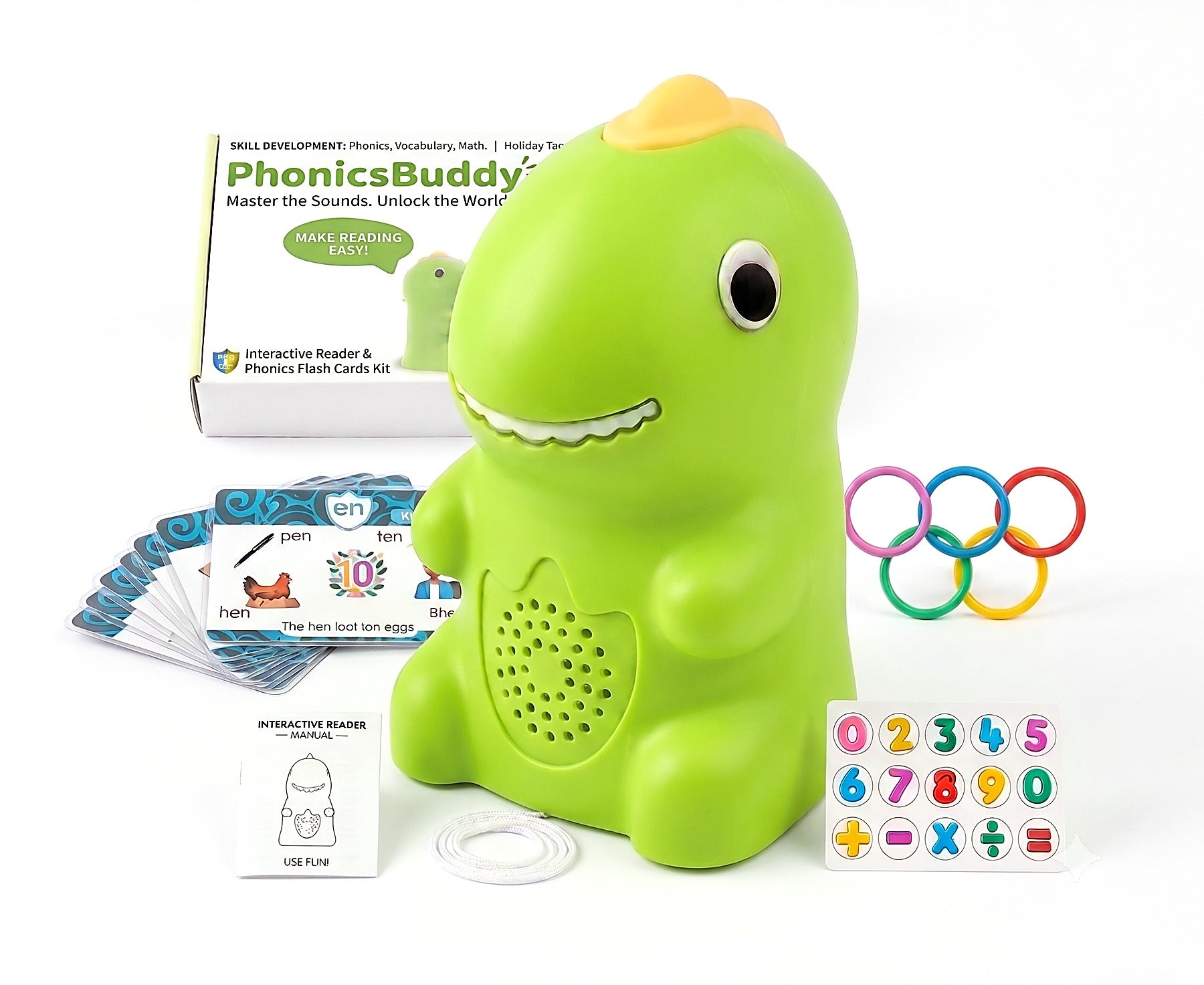
PhonicsBuddy Interactive Reader & Phonics Flash Cards Kit
"Easy to Use and a Great Learning Tool"
From customer reviews on our store.
The Real Risk Isn't Trying It. It's Another Month of Silent Screens.
I taught kindergarten long enough to see the same pattern every single year: the gap between readers and non-readers doesn't stay the same — it widens. The kids who crack the code early read more, enjoy it more, and pull further ahead every month. The kids who don't start avoiding it.
Every week in the Silent Screen Trap is another week your child's brain practices watching instead of speaking. The loop doesn't build itself. But given the right tool, it builds shockingly fast — kids' brains are built for exactly this.
Your child isn't behind because of who they are. They're behind because of what their tools left out. Fix the tool, and watch what happens.
Give Them the Say-It-Back™ Loop
The complete kit: dino reader · 75 double-sided cards · 90+ tap-to-read stickers · free travel case
PhonicsBuddy Interactive Reader & Phonics Flash Cards Kit